On 27 August, at the STACK Meetup [Data] in Punggol, GovTech Singapore's Data Practice showed its working. On 28 August, at Suntec, it launched the Standard Data Platform. Five golden paths onto Databricks, Snowflake, Microsoft, AWS and Google Cloud, with Microsoft Fabric now carrying Singapore data residency. Two days, two halves of one programme: the platform underneath, and the operating model on top of it.
It is very good, and it is built for government and the GLCs. So what happens everywhere else?
What they showed
Dr. Ghim-Eng Yap, who runs the Data Practice, set the frame to start. The government does not have a talent shortage. His words: "we don't lack data engineering talent, we need to enable our people to achieve even more for public good by adapting our workflows to leverage AI."
The move he describes is not faster typing. I am no authority on typing speed, having still not joined the whisper-flow revolution and continuing to enter text by hand, like a Victorian.
What he means is data engineers elevating "from repetitive manual builds to high-value orchestration and quality assurance standards at scale."
Janice Ng then laid out AIDE, AI for Data Engineering, as four pillars. Their wording, not mine.
Intent-driven data engineering, where the end goal guides architecting.
Contract-First Co-Creation.
Human-in-the-Loop, "always", because "humans develop the blueprint while AI lays the bricks."
Policy-as-Code Assembly, where "speed isn't enough, trusted speed i.e. speed with governance is the aim."
The slogans travel well. The mechanism underneath is the part worth copying, and GovTech has written it up themselves in more detail than a meetup allows.
A data user turns up with what they call a Golden Dataset, no more than ten records, plus plain-language context describing what the data should look like. An agent drafts a machine-readable data contract from it, with compliance rules from the Singapore Government Data Management Framework built in at the outset rather than bolted on at the end. The contract is converted into a test suite, which routinely surfaces gaps the data user had not thought of, and that loop repeats until the contract holds. Only then does the AI build the pipeline, adjusting until the tests pass.
Then the number. At the meetup it was one QA architect governing twenty AI-generated pipelines, with data engineers inverting from eighty per cent building to eighty per cent reviewing and setting standards.
GovTech's own write-up is more careful than that, and the care is worth respecting. AIDE began as a proof of concept. The early results are promising. A single engineer can support multiple data initiatives at once. Read the twenty as the shape of the bet rather than a number already banked, and it is still the most interesting figure anyone in Singapore has put on this.
Michael Han of Infinite Lambda followed with the evening's most honest hour: Mandai Wildlife Group's legacy on-premise warehouse moved to cloud in under a year, animal caretakers finally able to see observations, diagnoses, medication and enrichment in one place. He also said that his team built ten prototypes and two survived, and that the eight failures were worth what they cost.
His engineering rules were the kind that keep a relationship going rather than the kind that start one. Unglamorous, and load-bearing. Always query through the semantic model, never the raw tables. Validation logic stays human-authored and version-controlled. Human-led governance, where the right path should be the easiest and most obvious one.
And the line I have been recycling in customer calls ever since, credited here at last: agents that assert correctness without humility lose business users back to spreadsheets.
Debananda Ghosh from Microsoft made the fourth argument, that an ontology gives agents shared business meaning and that systems working from a single source of truth disagree with each other less. We agree with all of it. Our own work sits underneath the semantic layer, in the physical foundation that feeds it. Authoring on top of it is not something we are waiting to build. Microsoft publishes skills for Fabric covering semantic model authoring, Fabric IQ and the ontology CLI, and Studio takes user-added plugins today, so they run in it now. You do not need us for that. We are polishing our own side of it, agent identities and skills tuned for the work, which is ongoing and unglamorous.
The four things they had to build
On 6 August I counted fourteen hand-built components in one Microsoft principal engineer's harness and suggested that expecting every data team on earth to assemble the same fourteen was an odd way to run an industry.
GovTech's list runs to four, and the length is the point. Four pieces of tooling, built in-house, before the four pillars would carry any weight.
Test case generation
Data contract generation
Data pattern building
Synthetic data with PII shielding, so production records never reach a model
There is a fifth, and they have given it away. VOWL is their validation engine for Open Data Contract Standard contracts, MIT-licensed and on GitHub, and it is what enforces the contract against real data once a pipeline is live.
Those are not components. Each one is a small product, the kind of thing a vendor used to sell and an AI-native data engineer now builds themselves. Building one is the easy part. Each still arrives with a roadmap, a maintainer and a support burden, and GovTech ended up owning four of them because that was the shortest path to the operating model it wanted.
Different institution, different half of the stack, identical conclusion. Nobody sells this whole, so we built it.
One to twenty is not a productivity statistic
It is a statement about what the reviewer is permitted to skip.
At twenty pipelines a human being cannot read everything. They can only read what the system has already refused to let through. The ratio therefore holds exactly as far as the gates are mechanical, and not one pipeline further. Make the gates advisory — a standards document, a checklist, a well-intentioned paragraph in a prompt — and one-to-twenty becomes one person nodding at twenty things they have not read, which is not governance, it is a signature.
Janice Ng's refusal to embed AI dynamically inside data pipelines is that same position viewed from the build side. Decisions you count on cannot be left to dynamic generation. Michael Han's insistence that validation logic stay human-authored and version-controlled is the same position viewed from the operate side. Two speakers, two ends of a lifecycle, one evening, one refusal: the agent builds the machine, the machine stays deterministic, and trust arrives as evidence rather than as tone.
The fashionable answer runs the other way. Put the model inside the running system, where it demos magnificently and then reasons freshly about your revenue figure at two o'clock every morning. It lands on a slightly different answer each time and delivers all of them with total confidence. GovTech has, rightly, declined to do this.
What about everyone else
A Singapore government agency or GLC now has a standardised platform with five vetted paths, Fabric with local residency, a central Data Practice, four bespoke tools, contracts on an open standard, and an operating ratio with a number attached to it. That is a serious piece of institutional engineering, built for the public service by people whose job is the public service, and the agencies should have it.
They have also been unusually generous with it, which is the strongest objection to everything I am about to say, so let me put it up front. The AIDE write-up is public and detailed. It ends with six tips for applying the principles. It says plainly that those principles "aren't exclusive to government" and that any organisation can apply them. VOWL is on GitHub under MIT. This is an agency doing close to everything an agency can do to give the work away, and more than most private vendors would.
It still leaves you building it. Six tips and a validation engine are not a thing you can adopt on Monday morning. They are an excellent description of a destination and a genuinely useful component, which is not the same as the road.
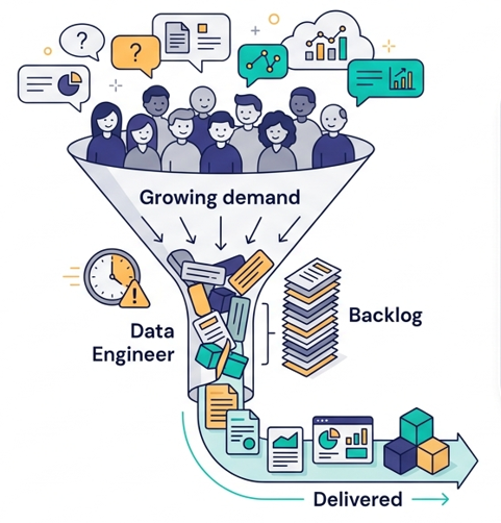
The rest of the economy wants the same thing and starts from somewhere else. The family-owned logistics group would also like trusted speed. So would the manufacturer in Tuas, the mid-sized insurer, and the systems integrator in Kuala Lumpur or Jakarta or Manila carrying eight clients and no central practice to build anything on their behalf. They do not lack the ambition. They lack the four tools, and the year it takes to build them.
The cost of that year is regressive. GovTech pays it once and spreads it across every agency in the government, which is exactly what a central practice is for.
A forty-person data team pays the same bill for one team. The integrator pays it per client. And the build is only the first invoice. You keep paying to keep up, every time a new model lands, every time the harness underneath shifts, every time four platforms version their APIs on four different schedules. The smaller you are, the larger the share of your engineering capacity it eats, and the less likely you are to start at all.
Which is a strange place for an industry to have arrived, given that the whole promise was leverage.
What we are building
Vibedata is your data engineering agent, and the harness around it — the isolation, guardrails, data engineering context and cross-platform reach that a general-purpose coding agent does not have the moment the work stops being application code and starts being somebody's ledger.
Gates are what makes a ratio real, and a gate is not the same thing as a good intention. Ours is not a checklist. It is the Semantic Branch.
A Semantic Branch is the working world for a single Intent, and it branches the work rather than merely the repository: the conversation, the code branch, the artifacts, and an ephemeral workspace on the data platform itself. The agent works inside it and has no view out.
Which means the interesting question stops being whether the agent is right. It will sometimes be wrong, because that is what reasoning systems do. The question is what a wrong answer can reach. Inside the branch, a bad transform meets an authorization failure rather than your tables, because no principal the agent can reach holds write access on the production resource. Reads pass through to live data, so it works against the real thing rather than a stale extract, and the write path is simply absent. The mechanism is native to each platform, which is the honest way to put it.
My favourite part is the unglamorous bit. Permissions alone turned out not to be enough, because a CREATE TABLE on a colliding name reports success and writes nothing, anywhere. So the shortcut is removed before anything can write that name. Somebody found that out the hard way, and now nobody else has to.
And nothing ships itself. Work leaves as a proposed change, and deployment to production stays in your own CI/CD, where it belongs. The agent has no route to production even if every reviewer in the building is asleep (they were up all night worrying about their BTO ballot number).
The review gates sit on top of that and they are real: an approved design before any code by default, evidence for every acceptance check that comes from somewhere other than the code being certified, and three hard stops the agent cannot infer from urgency or from silence, which are ship approval, a destructive schema change, and design approval. But they are the second line, not the first. Being wrong is survivable before anyone reviews anything.
That is the difference between a review ratio you can operate and one you can only put on a slide. Twenty pipelines is survivable when being wrong is cheap.
We run on Microsoft Fabric, MotherDuck and DuckDB today, with more platforms in flight. Vibedata is homegrown, born and built in Singapore. Not a moral claim, only an explanation of why the region's problems are the ones we picked first.
GovTech built those four tools because nobody was selling them. That was the right call, and a heavy one. Our whole argument is that you should not have to make it.
Sandbox provisioning opens on Friday 4 September. It is a seeded DuckDB environment with your own demo domain and your own GitHub repository, three worked examples already in it. Sign in with GitHub and it is yours. Request access, spend an evening in it, and tell us where our thinking is wrong.
The four tools are buildable. The year is not refundable. Which are you spending yours on?
VOWL — GovTech Data Practice's open-source validation engine for Open Data Contract Standard contracts. MIT licence.
GovTech Singapore STACK Meetup [Data], "Data Standards that Scale: AI-enabled Data Engineering" — 27 August 2026, GovTech, Punggol Digital District. Speakers: Janice Ng (GovTech Data Practice), Debananda Ghosh (Microsoft), Michael Han (Infinite Lambda); moderated by Dr. Ghim-Eng Yap, Head of Data Practice, GovTech Singapore.
GovTech Singapore, Standard Data Platform launch, "Five Golden Paths to a Standardised Data Landscape" — 28 August 2026, Suntec Convention Centre.
A software bug throws an error; a data bug lies silently for weeks. Why agentic data engineering needs a harness for Day-2 operations, not just build...
ShwetankJul 30, 2026
Stay in the loop
New Proof, Provocation, and Practice posts - straight from the team building the harness.